
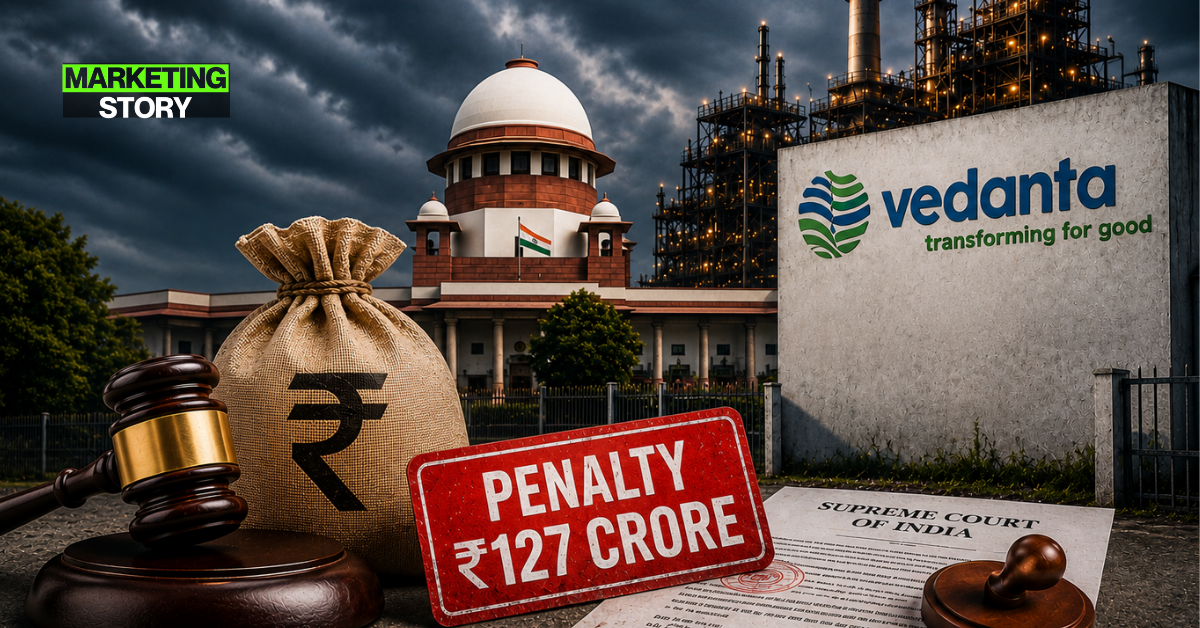
Vedanta has said that its subsidiary Talwandi Sabo Power (TSPL) will have to pay approximately ₹127 crore along with applicable late payment surcharge to Punjab State Power Corporation (PSPCL) following a ruling by the Supreme Court of India.
The development comes after the Supreme Court set aside an earlier judgment passed by the Appellate Tribunal for Electricity (APTEL) and restored the order issued by the Punjab State Electricity Regulatory Commission (PSERC).
According to Vedanta’s regulatory filing, the apex court upheld the alleged penalty imposed on TSPL for misdeclaration of power availability during January 2017 under provisions of the Grid Code.
Supreme Court Restores PSERC Order
The dispute relates to allegations that TSPL incorrectly declared power availability levels in January 2017, leading to regulatory action by the Punjab electricity regulator.
While APTEL had earlier granted relief to TSPL by overturning the PSERC order, the Supreme Court has now reversed that decision and reinstated the original penalty.
As a result, TSPL will now be required to pay approximately ₹127 crore along with additional late payment surcharge applicable under the order.
Industry experts say the ruling highlights the importance of strict operational compliance within India’s power sector, particularly concerning grid regulations and power availability declarations.
TSPL Plays Major Role In Punjab’s Electricity Supply
Talwandi Sabo Power operates a 1,980 MW super-critical coal-based thermal power plant located at Banawala in Punjab’s Mansa district.
The plant is considered one of Punjab’s major electricity generation assets and currently supplies 100% of its generated power to PSPCL.
According to the filing, TSPL contributes nearly 35% of Punjab’s total electricity requirements through large-scale thermal power generation.
Industry analysts believe the plant remains strategically important for Punjab’s energy stability, particularly during periods of peak demand.
Project Was Developed Under BOO Model
Talwandi Sabo Power was originally established as a special purpose vehicle by the former Punjab State Electricity Board for developing a large scale thermal power project in the state.
The project was later awarded to Vedanta, then operating through Sterlite Energy Ltd, under a Build Own Operate (BOO) model.
Over the years, the project has emerged as one of the key private-sector thermal power investments in Punjab.
Regulatory Compliance Under Increased Focus
The case also reflects increasing regulatory scrutiny across India’s power and utility sector.
Electricity regulators have been tightening compliance requirements related to generation availability, grid discipline and operational disclosures to ensure stability within the national power infrastructure.
Industry observers believe the Supreme Court ruling may reinforce stricter adherence to grid code regulations by power producers across the country.
At the same time, analysts note that despite the financial impact of the penalty, TSPL remains a strategically important power asset for both Vedanta and Punjab’s electricity ecosystem.
The development comes at a time when India’s energy sector is balancing rising electricity demand, renewable energy expansion and the continued importance of thermal power generation for grid reliability.