
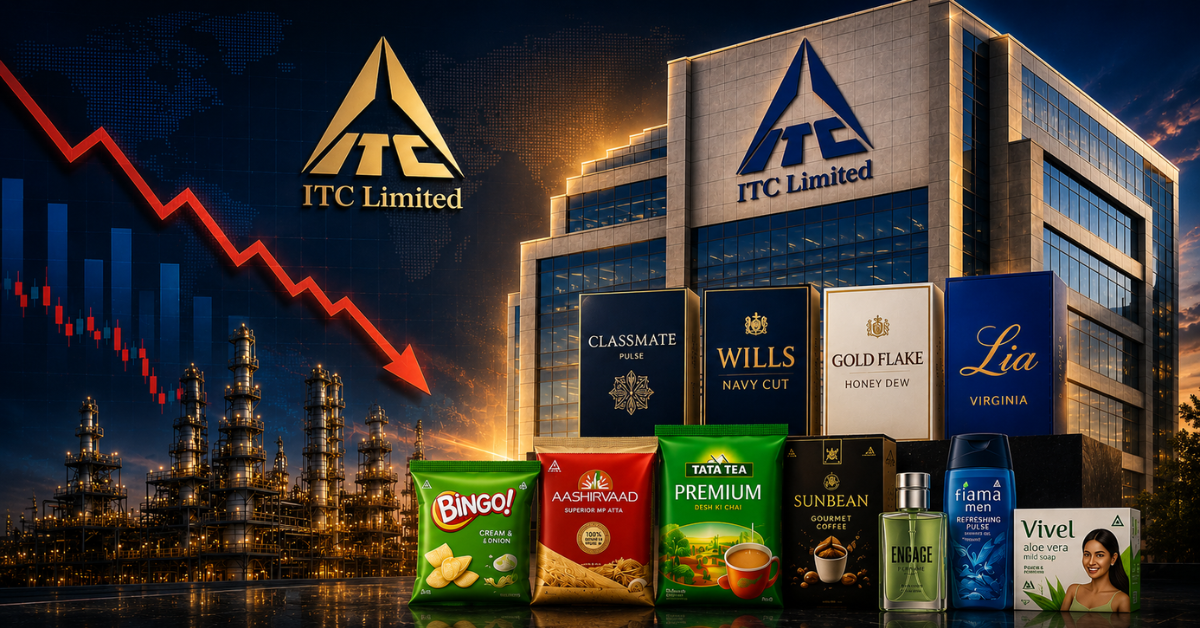
ITC reported a sharp decline in net profit for the fourth quarter of FY26, largely due to the absence of a one-time gain recorded during the same period last year following the demerger of its hotels business.
The company posted a consolidated net profit of ₹5,113 crore for the March quarter, marking a decline of nearly 74% compared to the year-ago period.
However, excluding exceptional items and tax adjustments, ITC’s underlying operating performance remained relatively stable.
The maker of Gold Flake cigarettes reported a 2% increase in profit before exceptional items and tax to ₹6,692 crore during Q4 FY26.
Hotel Demerger Impact Distorts Profit Comparison
The steep fall in reported profit was primarily due to a large one-time gain of ₹15,179 crore recorded in the corresponding quarter last year after the demerger of the company’s hotel business.
As a result, the year-on-year comparison appears significantly weaker despite continued growth across several operating segments.
Industry analysts said the latest earnings indicate that ITC’s core businesses continue to show resilience despite regulatory and taxation pressures impacting the tobacco industry.
Cigarette Business Continues To Drive Growth
ITC’s cigarette segment remained the biggest contributor to overall profitability during the quarter.
Revenue from the cigarettes business surged nearly 32% year-on-year to ₹11,066 crore during Q4 FY26.
The strong growth came after the company implemented price hikes across key cigarette brands following the increase in excise duty announced by the government earlier this year.
The revised tax structure came into effect in February and forced tobacco companies to recalibrate pricing strategies.
However, analysts at Goldman Sachs noted that ITC’s price increases across major cigarette brands ranged between 20% and 40%, which may still be insufficient to fully offset the higher tax burden.
According to analysts, this could create some near-term pressure on operating margins within the cigarettes business.
Despite the tax-related challenges, ITC managed to protect cigarette volumes through calibrated price increases rather than aggressive hikes.
FMCG Segment Continues Strong Momentum
Apart from cigarettes, ITC also reported strong performance in its fast-moving consumer goods (FMCG) business.
Revenue from the FMCG segment, which includes brands such as Aashirvaad, Sunfeast and Bingo, increased 15% year-on-year to ₹6,304 crore during the quarter.
Industry observers believe ITC’s FMCG business continues to benefit from rising rural demand, expanding distribution networks and strong brand positioning across packaged foods and personal care categories.
The company has also been steadily increasing investments in premiumisation and value-added consumer products to strengthen long-term growth.
Overall Revenue Rises 17%
ITC’s consolidated revenue from operations rose 17% year-on-year to ₹21,695 crore during the March quarter.
The growth was supported by strong performance in both the cigarette and FMCG segments, despite inflationary pressures and taxation challenges.
Analysts said ITC continues to maintain a balanced business model with strong cash flows from cigarettes helping fund expansion across FMCG, agriculture, paperboards and hospitality-related businesses.
Investors Watching Taxation And Margin Trends
Going forward, market participants are expected to closely monitor the impact of higher tobacco taxation on cigarette demand and margins.
The Indian government has periodically increased excise duties on tobacco products as part of public health and revenue mobilisation measures.
Industry experts believe ITC’s ability to balance pricing, profitability and consumption trends will remain crucial in the coming quarters.
At the same time, the company’s expanding FMCG portfolio is increasingly becoming an important long-term growth driver as it reduces dependence on cigarettes for future earnings growth.