
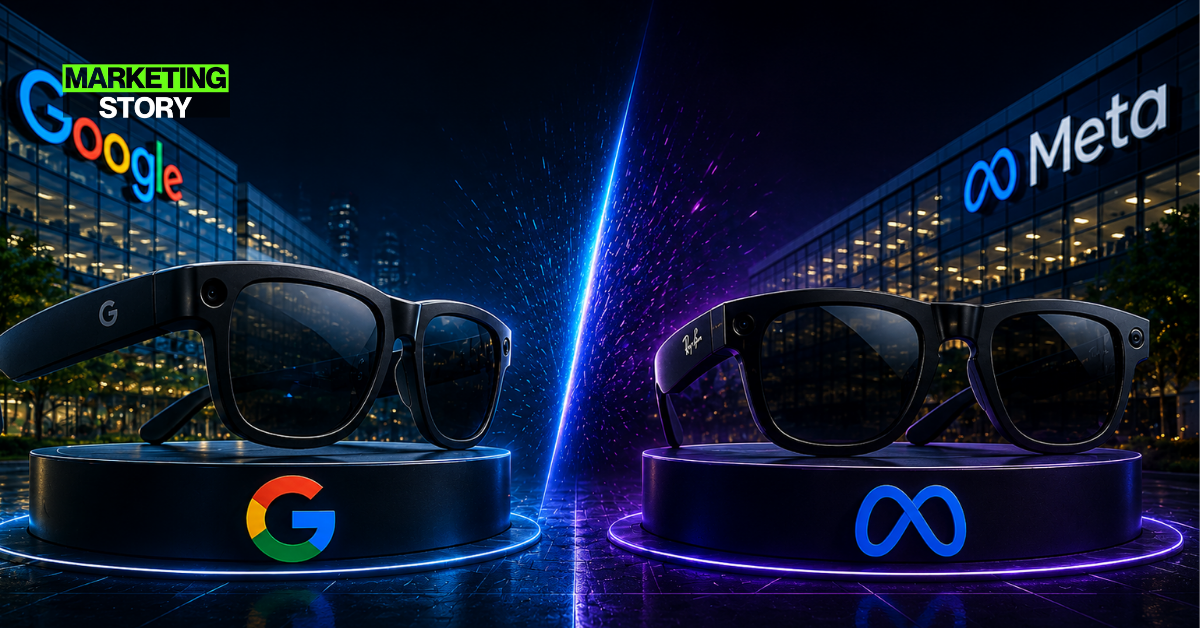
The global smart glasses market is entering a critical phase. After years of experimentation, limited consumer adoption and unclear use cases, the category is finally beginning to mature and artificial intelligence is becoming the defining layer driving this transition.
At its I/O 2026 conference, Google announced plans to launch Android XR-based smart glasses later this year in partnership with Samsung, Gentle Monster and Warby Parker.
The timing is significant because the smart glasses market is now growing at a pace rarely seen before. According to industry estimates, shipments are accelerating rapidly as consumers increasingly move toward AI-powered wearable devices that can deliver real-time assistance, contextual computing and hands-free interactions.
However, despite the excitement around the category, the competitive landscape is already heavily concentrated.
Meta Currently Dominates The Market
Meta has emerged as the clear market leader in smart glasses globally.
According to Counterpoint Research, Meta accounted for more than 80% of global smart glasses market share during the second half of 2025. In India, CyberMedia Research (CMR) estimated that Meta controlled nearly 85% of smart glasses shipments during CY2025, largely driven by the popularity of its Ray-Ban smart glasses portfolio.
The company’s success reflects how quickly AI-first wearable devices are becoming mainstream compared to earlier generations of connected eyewear.
Unlike older smart glasses that mainly acted as notification extensions for smartphones, newer AI-powered glasses are increasingly positioned as edge AI devices capable of understanding context, processing voice commands and interacting with the real world in real time.
Smart Glasses Are Splitting Into Multiple Categories
One major shift in the market is that smart glasses no longer represent a single product category.
The market is now broadly dividing into three layers:
- Basic smart audio glasses
- Camera plus AI-enabled glasses
- Full AI and display-based smart glasses
The strongest growth is clearly happening in AI-driven devices.
Counterpoint Research estimated that AI smart glasses accounted for nearly 88% of global shipments during the second half of 2025. In India, CMR data showed that standalone AI smart glasses contributed nearly 84% of the category’s revenue despite lower shipment volumes.
This suggests the real value in the market is increasingly concentrated around AI-first devices rather than basic wearable accessories.
Google’s Biggest Strength Is Its Ecosystem
Google’s strategy differs fundamentally from Meta’s approach.
Meta has built its smart glasses business through a vertically integrated model where the company controls both hardware and software. This allows Meta to optimise battery life, performance and feature rollout more tightly across devices.
Google, however, is attempting something broader.
Through Android XR, Google is positioning smart glasses not simply as a standalone product but as part of a larger ecosystem similar to Android smartphones.
Because Google already controls Android, Wear OS and a massive developer ecosystem, it has the potential to create a shared platform for multiple smart glasses manufacturers.
This could allow different hardware companies to build Android XR-based glasses across various price segments, styles and use cases.
Industry experts believe this ecosystem-led approach could significantly accelerate adoption because it expands hardware availability and encourages developers to build native applications specifically for smart glasses.
But Ecosystem Expansion Could Also Create Fragmentation
Google’s open ecosystem strategy also introduces risks.
If multiple manufacturers adopt Android XR differently, user experiences may vary significantly between devices.
Some smart glasses may support advanced AI capabilities while others may not. Software updates could arrive unevenly, and developers may need to optimise applications across different hardware configurations.
This fragmentation is similar to challenges Android smartphones faced during their early years.
However, fragmentation is not always negative. It can also encourage experimentation, affordability and innovation across different market segments.
Some manufacturers may focus on premium AI experiences, while others target enterprise applications, fitness or affordable consumer products.
AI Will Decide The Long-Term Winner
The biggest battle between Google and Meta may ultimately come down to artificial intelligence rather than hardware.
Meta’s glasses are powered by Meta AI and are closely integrated with apps like Instagram, Facebook and WhatsApp.
Google, meanwhile, is building around Gemini and agentic AI workflows capable of interacting across multiple services and devices.
If Google successfully extends Gemini’s multi-app task execution capabilities into smart glasses, the device could evolve from being a smartphone companion into a continuous AI interface that operates seamlessly across digital environments.
That could fundamentally change how people interact with technology.
The Market Is Still In Its Early Stages
India is expected to become one of the fastest-growing smart glasses markets globally.
According to CMR, India’s smart glasses market could expand more than sixteenfold to cross 3.2 million units by 2030.
At the same time, reports suggest OpenAI and Apple are also exploring AI-first wearable devices and smart glasses initiatives.
This means the market is still far from settled.
While Meta currently dominates through early product-market fit and ecosystem integration, Google’s Android XR strategy could reshape the category if it succeeds in building a scalable developer and hardware ecosystem similar to Android smartphones.
The next few years may ultimately determine whether smart glasses become the next major computing platform and whether Google can challenge Meta before the category fully matures.