Why Did The Delhi High Court Reject Telegram’s Challenge?
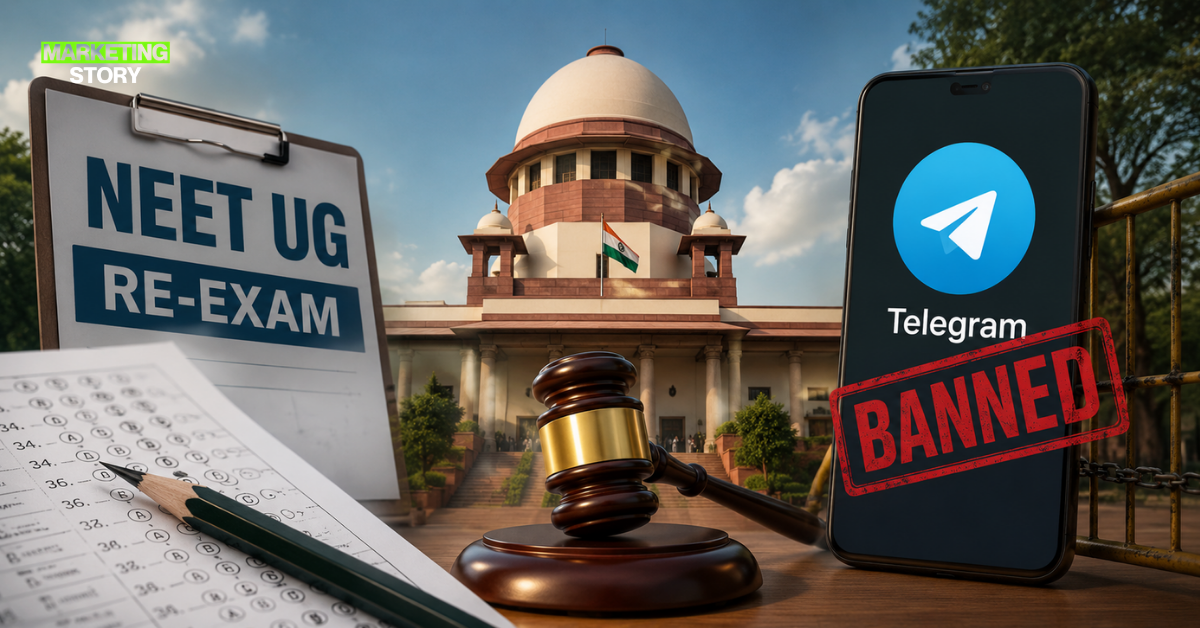
The Delhi High Court on Friday upheld the Centre’s decision to temporarily restrict access to Telegram in India ahead of the National Eligibility-cum-Entrance Test Undergraduate (NEET-UG) 2026 re-examination, delivering a significant legal victory to the government and the National Testing Agency (NTA).
A vacation bench led by Justice Tejas Karia ruled that the temporary restriction was neither excessive nor disproportionate, observing that the government’s action represented the “least restrictive” measure available under the circumstances.
The court further held that the Centre possessed the legal authority to issue such directions under existing provisions of the Information Technology Act, 2000.
The ruling comes just a day before the highly anticipated NEET UG re-examination scheduled for June 21, which is being conducted following allegations of a question paper leak in the original examination held earlier this year.
What Prompted The Temporary Telegram Restriction?
The controversy traces back to the cancellation of the May 3 NEET-UG examination after widespread allegations of malpractice and paper leaks surfaced across multiple states.
Following investigations, the National Testing Agency cancelled the examination and announced a re-test for affected candidates.
According to government authorities, several Telegram channels and groups were allegedly being used to circulate misleading claims, fake question papers, and fraudulent offers promising access to examination material in exchange for money.
Officials argued that despite repeated efforts to remove individual groups and channels, new networks continued to emerge rapidly, making platform level intervention necessary.
As a result, the Ministry of Electronics and Information Technology (MeitY), acting on recommendations from the NTA, issued an order on June 16 restricting access to Telegram in India until June 22.
The restriction covers the examination period and its immediate aftermath.
What Did Telegram Argue Before The Court?
Telegram challenged the government’s action before the Delhi High Court, arguing that the restriction was excessive and unfairly impacted ordinary users.
The company’s legal counsel informed the court that more than 150 million users in India were affected by the temporary suspension.
Telegram questioned the legality and proportionality of the government’s decision, contending that blocking an entire platform penalized millions of legitimate users rather than targeting the individuals responsible for spreading misinformation.
The company sought urgent relief from the court to restore access ahead of the examination.
However, the High Court ultimately sided with the government’s position.
What Did The Court Say?
While the detailed judgment is yet to be released, the court observed during pronouncement that the government’s action was not disproportionate and represented a calibrated response to an extraordinary situation.
Justice Tejas Karia noted that the Centre was empowered under law to direct temporary blocking of access when required in the interest of public order and examination integrity.
The court also accepted the government’s argument that less restrictive measures had already been attempted before resorting to a temporary platform-level restriction.
Why Was Telegram’s Editing Feature Also Disabled?
Alongside the temporary access restriction, authorities directed Telegram to disable its message-editing functionality for already-posted messages in India until June 30.
The NTA argued that the feature had been exploited in previous examination controversies.
According to investigators, administrators could edit older messages after an examination had concluded and insert actual question papers while retaining the original timestamp.
These manipulated screenshots were then circulated as purported evidence that examination papers had been leaked before the test.
Officials claimed that disabling message editing would prevent the creation of fabricated “paper leak” narratives and reduce misinformation after the re-exam.
What Happens Next?
With the High Court declining to interfere, the government’s restrictions remain in force.
The NEET-UG 2026 re-examination is scheduled to proceed on June 21 under heightened security and monitoring arrangements.
Meanwhile, the Central Bureau of Investigation (CBI) continues to probe the alleged paper leak that led to the cancellation of the original examination.
The case has triggered broader debates around examination security, digital platforms, misinformation, and the extent of government powers during sensitive national events.
For now, the Delhi High Court’s ruling reinforces the government’s position that extraordinary circumstances can justify temporary digital restrictions when aimed at protecting the integrity of large-scale public examinations.